Automated Database Migration Safety in Continuous Deployment
Expand-and-contract and gated stages keep schema changes from causing outages.
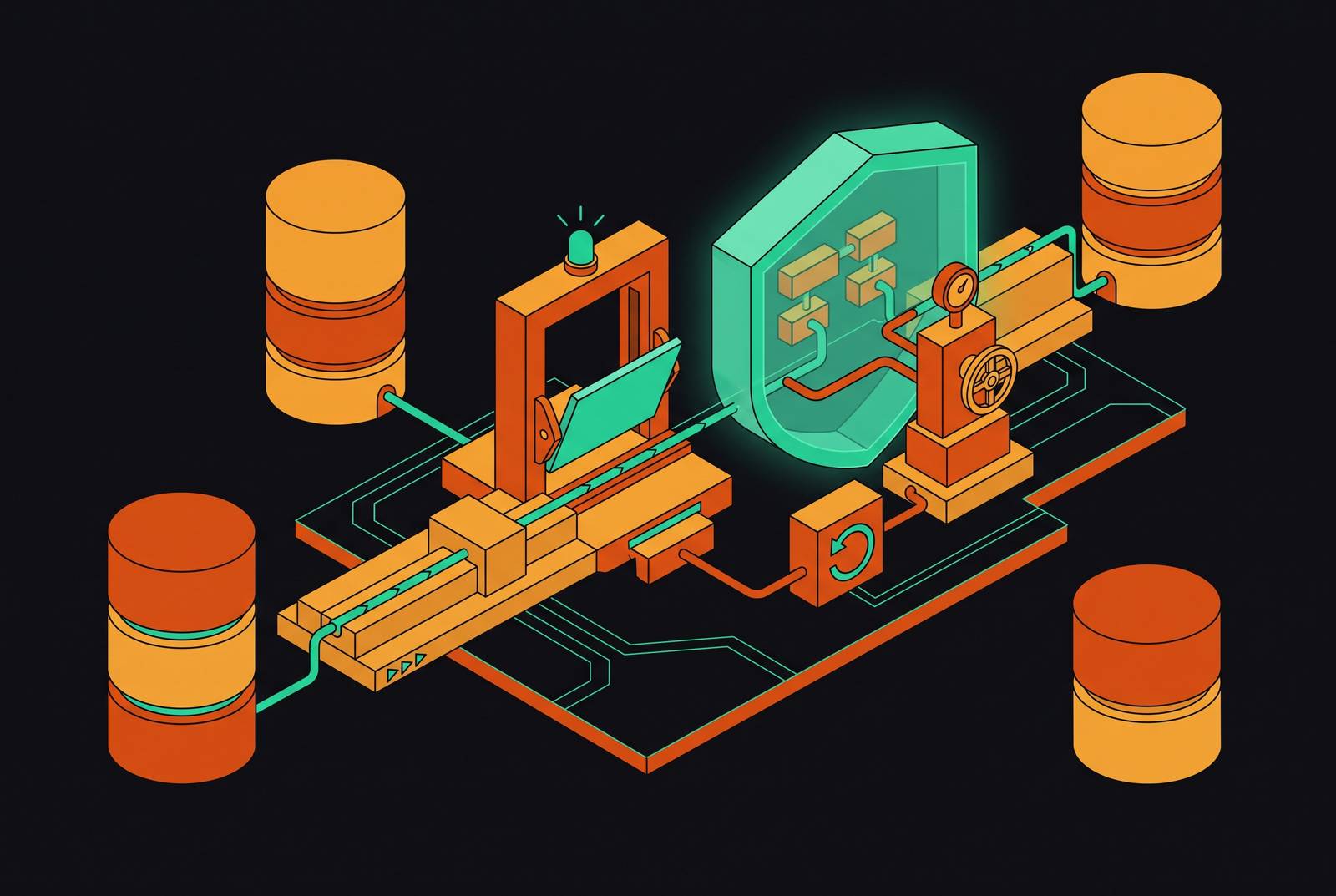
Automated database migration safety in continuous deployment means making automation respect a database’s state. Schema changes need a framework that enforces backward compatibility, staged execution, and tested rollback paths. Treating schema changes like ordinary code releases can make a fast pipeline a fast route to an outage.
Why schema changes break rolling deployments when code changes don't
Code rolls back by swapping a container image. Schema changes do not roll back that way. If a migration drops a column, restoring the old application image does not restore its data. Instead, the old application starts reading a column that no longer exists.
During a rolling update, old and new application versions share one database. The same overlap can happen during a blue-green cutover or staged rollout. A migration that assumes the new version is already the only reader therefore starts from a false premise. Removing a column can break older instances, while adding a NOT NULL constraint can reject writes from pods that have not yet received the code that populates it. A schema can be correct for the final release and still be wrong for the deployment that gets there.
The GitHub June 2025 incident shows how linked failures can spread, though it was not a schema-migration failure. An internal load spike exposed a latent misconfiguration that throttled requests on the critical path for starting workflow runs. Failures cascaded across repositories, pull requests, and GitHub Actions, freezing the ability to ship for companies using continuous deployment. In a rolling deployment, the database is a shared dependency, so its state must work with more than just the last application version to arrive.
Why locking is the most common mechanism by which a migration kills a live system
Lock contention is the most common way a migration turns into a live-system outage. Operations that change the schema, known as DDL, take locks, and a busy table may already have long-running transactions. Even a migration that executes quickly can spend a long time waiting behind those transactions. While it waits, its lock request can block queries that come after it. The danger is therefore not just how long the SQL takes once it starts, but what queues behind it before it can finish.
On PostgreSQL older than version 11, adding a column with a non-null default rewrites the entire table while holding an ACCESS EXCLUSIVE lock. The example ADD COLUMN status VARCHAR(20) NOT NULL DEFAULT 'pending' on a 140M-row orders table can hold that lock for 20–40+ minutes on those older versions. PostgreSQL 11+ handles a constant-default ADD COLUMN as a near-instant metadata-only operation. The SQL looks the same, but its production impact is radically different.
Backfills create a separate source of pressure even when the schema change itself is safe. Updating millions of rows in one transaction can cause replication lag, high CPU, and lock pressure. Concurrent migration jobs add another hazard because multiple pipeline runs can race against the same schema and corrupt it. Large, high-write MySQL tables present a further limit because the engine’s online DDL is often insufficient. These are different failure mechanisms, but they share a cause that a successful test on a small, quiet database can hide.
The expand-and-contract pattern as the structural answer to dual-version compatibility
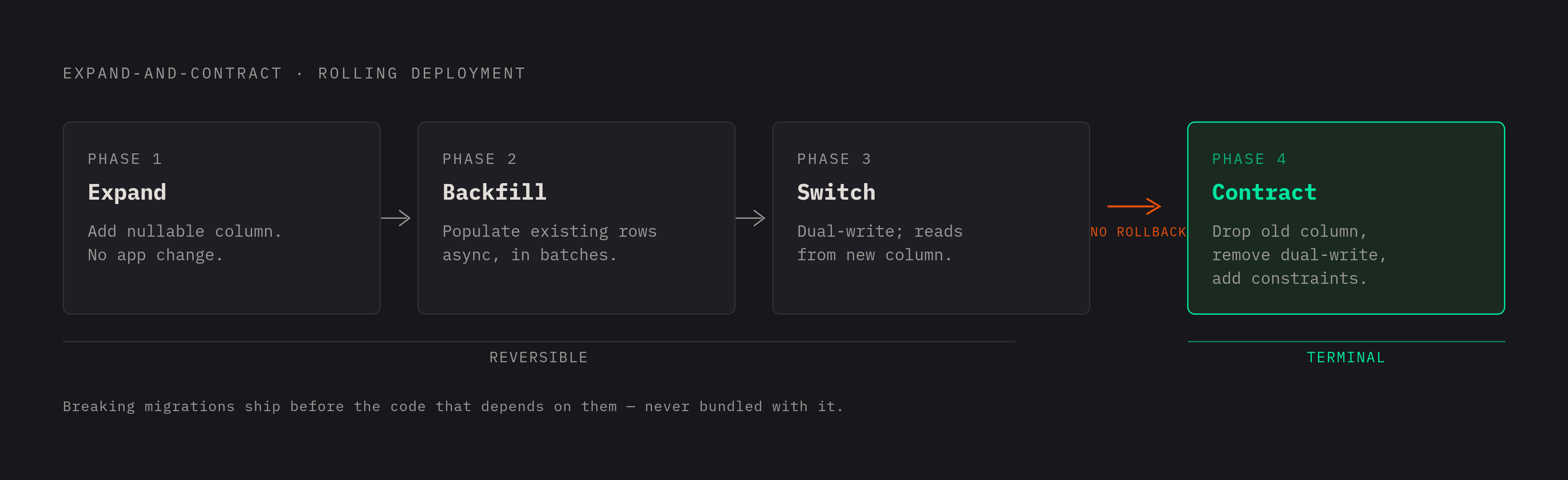
Because application versions share the database for part of a rollout, expand-and-contract is the default way to make schema changes in rolling deployments. Instead of replacing the schema in one move, the pattern keeps the old structure available while the application moves to the new one. Its four phases are expand, backfill, switch, and contract, each handled as a separate deployment. Combining them in one release removes the separation that makes the pattern useful. The governing rule is simple. Never bundle a breaking migration inside the same deployment artifact as the code that depends on it.
The expand phase adds the new column or table while keeping the old one. The new structure is nullable or has a default, and this migration deploys without an application code change. Backfill then populates existing rows asynchronously in batches through a background job or separate data-migration script. This asynchronous backfill separates the work of moving stored data from the work of changing the application.
The switch phase deploys code that writes to both old and new columns but reads from the new one. With the old column still there, older instances can keep writing to it during the rollout. Contract follows only after the new code is fully rolled out and verified, when the old column can be dropped and remaining constraints added. Dual-write logic is removed in the next release. Compatibility during the transition, rather than tidiness in the final schema, determines the order.
Rollback readiness changes as the phases advance. Once the application writes values to the new column, dropping that column as a rollback is no longer a harmless reversal. A down script cannot make destructive changes lossless simply because it runs successfully. The Cassandra startup failure shows the cost of compressing this process under schedule pressure. Skipping rehearsal and treating a schema overhaul as a same-quarter deliverable consumed the entire engineering team and nearly destroyed the company.
What a safe migration pipeline stage actually looks like in practice
A safe migration runner belongs in a dedicated, gated pre-deployment stage. The migration job must finish successfully before application containers are provisioned and the rolling update begins. That ordering gives the application the schema it expects before deployment starts. It does not replace backward compatibility, because older pods still use the database while the migration runs.
Harness CD and Database DevOps demonstrate this structure in a unified pipeline. A DBSchemaApply step uses Liquibase to apply the migration, followed by K8sRollingDeploy after success. The deployment can stand only if it passes health verification. On failure, DBSchemaRollback and K8sRollingRollback provide the database and application rollback steps. StageRollback StageRollback is the failure strategy action.
The runner needs a dedicated migration_user with only DDL and necessary DML privileges. It connects directly to the primary, bypassing PgBouncer or ProxySQL in transaction mode because DDL requires persistent sessions. An explicit lock wait timeout, such as PostgreSQL’s lock_timeout = '5s', makes a blocked migration fail when the timeout expires. Database-level advisory locks serialize concurrent runs, using pg_advisory_lock in PostgreSQL or GET_LOCK in MySQL. Before live execution, a preview runs against a restored production backup in staging.
Migration scripts must also be version-tracked and idempotent, so repeating an applied change is a no-op. Their down migrations need tests against real data volumes. Failure handling then follows the failure type. DDL timeout or lock contention calls for automatic cancellation and an off-hours retry with a higher timeout, while a data integrity violation calls for the tested down migration immediately. An application error spike after deployment calls for coordinated application and database rollback, subject to what can still be safely reversed.
How to choose a migration tool when the options split between declarative and imperative camps
Tool choice starts with how the team wants to describe change. Imperative tools follow a history of instructions in order, while declarative tools compare the schema the team wants with the live database. That difference shapes drift detection, how changes are reviewed, and what the pipeline can catch before a migration runs. It does not decide whether staged compatibility is necessary. The tool’s job is to enforce the framework.
Flyway from Redgate suits teams that want explicit, versioned SQL scripts. It applies them in deterministic order and tracks which migrations have run so they are not reapplied. This makes the intended sequence clear, but Flyway has no built-in online schema change. Large-table work therefore needs a separate tool such as gh-ost or pt-online-schema-change.
Atlas from Ariga supports both declarative apply and versioned migrations. Its declarative mode diffs the live database against the desired state, while its migration workflow can generate and lint scripts for destructive operations. Atlas Cloud adds automated drift detection to catch divergence between deployments. This matters because a reviewed migration plan can start from the wrong assumptions if the live schema has changed outside that plan. Atlas’s schema-as-code model makes that gap an explicit part of the workflow.
GitHub’s gh-ost addresses the narrower problem of online ALTER TABLE operations on large MySQL tables. It copies data to a shadow table and reads row-level changes from the binary log to stay synchronized with live writes. Unlike the trigger-based pt-online-schema-change, gh-ost uses no triggers and can throttle against replication lag, which suits high-write workloads. Across these choices, the framework calls for an unsafe-DDL linter, a CI drift check, and rehearsal on a production-sized copy for every release. Bytebase, Liquibase Secure, and Atlas also offer LLM-based review or natural-language translation, which raises the question of who can approve a change.
Where AI agents genuinely help in the migration pipeline and where they should stop
AI agents are useful when they turn a proposed schema change into a specific risk assessment. A planning agent can check table size, current query patterns, and DDL lock behavior to judge SQL in the database where it will run. It can classify a change as safe-online, requires-maintenance-window, or needs-manual-review. It can then generate an execution plan, rollback script, and monitoring checklist. In this framework, a person reviews and approves that plan before execution.
The PostgreSQL default-column example shows why this is more than automated proofreading. A generic instruction to run migrations in CI treats a table rewrite and a metadata-only change alike. An agent that considers the actual database version and table size can flag that distinction and make the risk clear to the reviewer. Deploy-ordering checks and runbook generation also help the reviewer see the risk. They give the reviewer more to go on while leaving control of production with a person.
Atlas takes a different position on the approval boundary through its lint-driven review policies. Its default workflow requires human verification of SQL, but configured policies can approve changes whose lint results meet the threshold and hold others for review. People still disagree over whether clean automated checks provide enough evidence to authorize execution without manual approval.
For this framework, the boundary remains human sign-off on the specific production plan. Accepting a maintenance window is a business decision, and accepting a rollback’s data-loss implications is not a task to delegate blindly. A person still needs to review and test a down migration that an agent generates. The agent’s role is to explain exactly how risky the change is and what could go wrong. Keeping that planning role separate from execution preserves the approval gate that the rest of the pipeline depends on.
The organizational practices that make the technical framework stick
The framework fails if schema work remains a configuration detail delegated to the ORM. Someone has to be in charge of the migration stage, the rehearsal environment, the rollback tests, and the compatibility checks. Every migration file needs a tested down migration before it merges. Every change that could break existing clients needs to be spread across deployments, with time to go beyond a single release.
Shopify’s Schema Migrations Service provides a concrete model for separating developer work from safety enforcement. Developers write vanilla Rails migrations, while the centralized service enforces safety and zero-downtime execution. The model does not require every developer to become an expert in lock behavior. Instead, it puts that knowledge into the system through which changes run.
That same discipline makes rehearsal on a restored production backup a release requirement. A small test database can miss problems with lock duration and performance that occur when a migration runs against production-sized data. Dedicated credentials, explicit timeouts, drift checks, and asynchronous backfills make the controls repeatable. Tested rollback paths make the limits of recovery visible before an incident. Continuous deployment can extend to the database, but only when schema changes become first-class delivery artifacts with their own compatibility, execution, and recovery rules.