Feature Flag Infrastructure Without the Vendor Tax
Self-hosting on OpenFeature keeps flag costs flat and your backend swappable.

Feature flags have become core infrastructure, and the vendor pricing models have not caught up to that reality. The cost of a flag vendor compounds at three levels: seat and usage pricing, analytics data routed off your infrastructure, and switching costs baked into direct SDK instrumentation. The practical way out is a self-hosted stack built on the OpenFeature standard, so the backend stays swappable and the bill stays flat.
Why feature flags became expensive infrastructure, not just a developer convenience
Feature flags started as a developer convenience, a way to hide half-finished work behind a toggle. They have since become the standard way to handle progressive delivery, kill switches, A/B testing, and entitlements. That shift makes the vendor choice a structural cost decision, not a tool preference.
The conceptual foundation is the deployment-versus-release split. Code ships dark, then flag evaluation controls who sees it and when, without another deploy cycle. That split is now load-bearing for how serious engineering teams operate.
Modern flag platforms bundle kill switches, gradual rollouts, A/B experimentation, targeting, audit logs, and governance into one product. That bundling is exactly what makes them expensive. LaunchDarkly bills $10 per service connection per month on annual billing. You are buying a control plane.
Flags embed deeply into application code at the SDK call level. Every service that evaluates a flag has made a commitment at instrumentation time. The vendor choice is therefore not just a pricing decision. It is a switching-cost decision made long before the first renewal negotiation.
The three levels where the vendor tax actually compounds
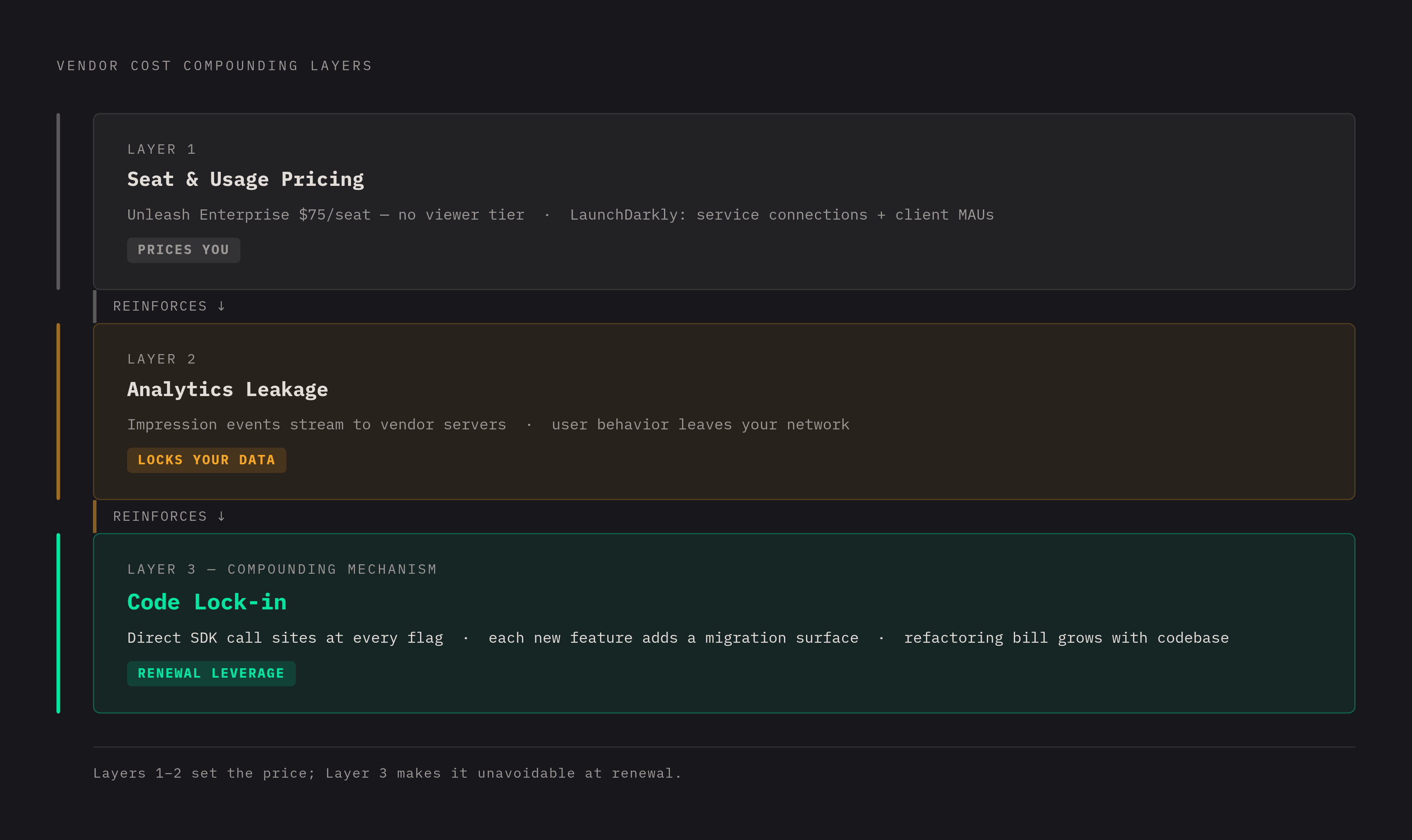
The vendor tax operates at three compounding levels: direct seat or usage pricing, analytics data routed off your own infrastructure, and switching costs baked into direct SDK instrumentation. Most teams only price the first one, which is why the total cost comes as a surprise later. Level one is seat or usage pricing. Unleash's enterprise tier costs $75 per seat per month, and there is no viewer-only seat, so costs climb once non-engineering teammates need access. LaunchDarkly bills on service connections plus client-side monthly active users, so your bill moves on traffic you cannot fully forecast.
The billing model matters more than the sticker price. Seat-based, request-based, event-based, and other usage-based models each expose you to different cost spikes at growth inflection points. You may forecast seats and find yourself paying for events instead.
Level two is analytics leakage, and it is the one most teams miss entirely. Most feature flag platforms generate analytics by sending impression events to an aggregation endpoint. Flags stay inside your network, but user behavior data leaves it on every evaluation.
Teams that miss this split can discover at audit time that flag exposure events are stored on a third-party server, not their own. The practical test is simple: can you tie a flag exposure event to a business metric without sending exposure data to the vendor's servers? If that requires an outbound API call to a third-party endpoint, the analytics fall short of the self-hosting requirement.
Level three is switching costs from direct SDK instrumentation. Flags get embedded at SDK call sites across services and languages. When you make those calls directly against one vendor's SDK, every service that evaluates a flag becomes a migration surface if you switch.
This is the compounding mechanism. The longer a team instruments directly against a single vendor, the larger the refactoring bill becomes, and the more the vendor's renewal leverage grows. The three levels reinforce each other: level one prices you, level two locks in your data, and level three locks in your code.
Why OpenFeature changes the switching-cost calculation
OpenFeature decouples feature flag logic from the vendor providing it. Application code calls the OpenFeature API, and the vendor sits behind a provider interface. The backend becomes a swappable infrastructure decision rather than a permanent commitment. OpenFeature is an incubating CNCF project, meaning it has met the foundation's standards for stability, adoption, and community support. It has provider implementations covering most major feature-flag vendors and self-hosted backends.
What OpenFeature standardizes is specific. The evaluation API: getBooleanValue, getStringValue, getNumberValue, getObjectValue. The evaluation context: the user and request attributes used for targeting. Hooks: before, after, error, and finally lifecycle hooks. Providers: vendor or self-hosted backend adapters. And OpenTelemetry hook integration for evaluation events, which is opt-in and emits span events, log events, or standalone spans depending on SDK and configuration.
What OpenFeature does not standardize is equally important. Providers still own the flag definition format, targeting rule syntax, and experiment design and statistics. The standard covers evaluation, not administration.
The single-service objection is fair. For a small team evaluating a handful of flags through one vendor's SDK, the abstraction layer adds ceremony. The counter is not that OpenFeature is always the right call. It is that the point where it pays for itself arrives earlier than most teams expect, specifically the moment a second service in a different language needs the same flags.
Three self-hosted backends worth evaluating behind OpenFeature
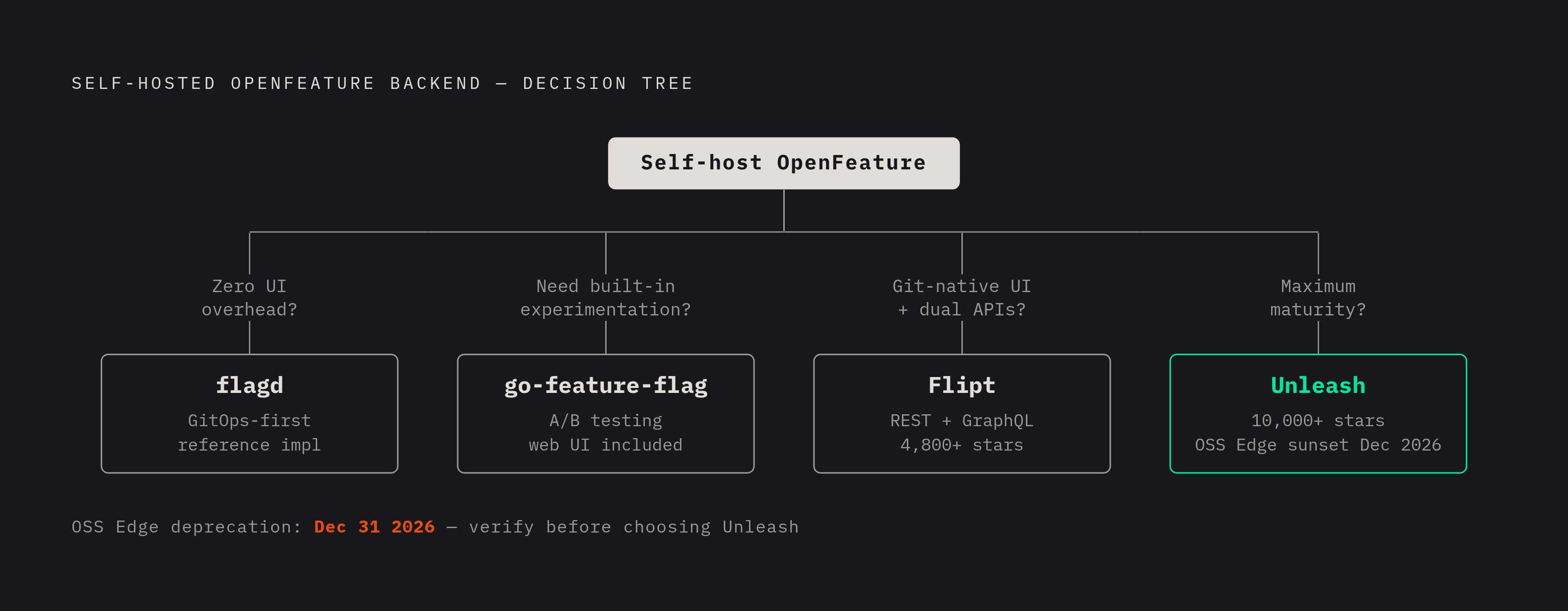
Three self-hosted backends implement the OpenFeature provider protocol and can be deployed on your own infrastructure. Each makes a different trade between operational simplicity, feature depth, and governance readiness. flagd is the OpenFeature reference implementation. It is a lightweight daemon with minimal resource footprint. Flag sources include files, HTTP, gRPC, and Kubernetes custom resources. There is no built-in UI, no A/B testing, and no experimentation. Configuration is via YAML and JSON files, which requires external tooling for flag management workflows.
go-feature-flag is a lightweight complete platform. It is a self-hosted flag evaluation engine with a web UI, advanced targeting with user segmentation and percentage rollouts, and built-in A/B testing and experimentation analytics. It supports multiple data store backends: PostgreSQL, MongoDB, and Redis. File-based configuration supports GitOps workflows.
The trade-offs are honest. It is less enterprise-hardened than commercial alternatives, the UI is functional but less polished than Flipt's, and the documentation could be more comprehensive. go-feature-flag fits teams that want a complete self-hosted solution including experimentation without a separate analytics tool. The Docker image is gofeatureflag/go-feature-flag:latest.
Flipt is Git-native and enterprise-ready, with over 4,800 GitHub stars. The server is Fair Core Licensed, while client SDKs are MIT. Backends include PostgreSQL, SQLite, MySQL, CockroachDB, and LibSQL/Turso. There is no built-in A/B testing or experimentation engine. Flag evaluation only, with experimentation requiring an external tool. Flipt fits teams that want GitOps-native flag management with a polished UI and dual REST and GraphQL APIs, particularly in environments where Git is already the source of truth for infrastructure config. The Docker image is docker.flipt.io/flipt/flipt.
What Unleash adds and what it costs at the open-source boundary
Unleash is the most established open-source feature flag platform, downloaded millions of times and trusted by large organizations including Visa, Wayfair, and Lloyd's Banking Group. Its open-source boundary has shifted, and that shift carries real operational implications. The license change came with v8.0.0, when Unleash's OSS source moved to AGPLv3.
The bigger structural change is Edge. The OSS Edge version will reach end-of-life on December 31, 2026, after entering long-term support in December 2025. After that date, edge-based flag evaluation requires Enterprise Edge, which is paid. That shifts the cost floor for any team relying on edge evaluation. Enterprise Edge streaming via Server-Sent Events is a beta feature as of June 9, 2026, and streaming is not available in the OSS edition at all.
The free tier has other boundaries worth pricing in. There is no built-in experimentation or statistical engine, so analysis requires an external tool. The read-only role exists but is billed at the full seat price, so non-engineering stakeholders who need visibility require full paid seats. Frontend SDKs do not evaluate flags locally, and the built-in Frontend API cannot be scaled horizontally and is not designed for large volumes. Unleash does support OpenFeature through official providers. It is that the free and paid boundary is more consequential than it looks, and teams should price the full picture before committing.
The hidden operational costs that offset the licensing savings
Self-hosting eliminates the seat bill but substitutes operational costs that are real, ongoing, and easy to undercount at the time a team makes the switch. The honest accounting matters, because the recommendation that follows depends on it. The team owns Postgres backups and upgrades, flag-server upgrades on the vendor's release cadence, and SDK compatibility checks across every app on each upgrade cycle. Local evaluation provides resilience: if the central flag server goes unreachable, the local cache serves evaluations from its last known state. That resilience only holds if the caching and sync infrastructure is properly maintained.
Governance gaps in free tiers are predictable. Open-source editions typically differ from paid plans in multi-environment management, RBAC granularity, approvals workflows, and audit log exportability. Vendor-managed dashboards do not satisfy a compliance audit.
Stale-flag accumulation is a quiet tax of its own. Flag systems accumulate dead flags over time. Without tooling or process discipline, the flag namespace becomes a maintenance burden that grows with your team.
A middle path exists. A single-tenant cloud deployment, where the vendor manages infrastructure but keeps the instance isolated, sits between full self-hosting and shared SaaS. It trades some data control for less operational burden, so it is worth evaluating if your residency requirements are moderate rather than contractually mandated. LaunchDarkly has SDKs across server, client and edge platforms for teams that go this route.
How flag infrastructure becomes an ML deployment primitive
For teams shipping production AI, feature flags solve a problem that has no equivalent in traditional software. LLM providers can update the underlying model, so behavior can shift with no action from you. You need a rollback that does not involve redeploying your application.
One engineering default is worth establishing early. Start new LLM flags at a small initial traffic slice with a config object rather than a boolean. It costs nothing extra at instrumentation time and avoids a rewrite later when the use case inevitably requires more than an on/off switch.
What a practical self-hosted flag stack looks like end to end
A self-hosted flag stack that escapes the vendor tax requires four components working together: an OpenFeature-instrumented application layer, a self-hosted evaluation backend, local evaluation with a managed cache, and an impression event pipeline routed to an analytics backend the team controls. The instrumentation layer is the OpenFeature SDK. All SDK calls go through the OpenFeature API. The provider is registered at startup and can be swapped without touching evaluation call sites across the codebase. SDKs are available for Java, Go, JavaScript, Python,.NET, Ruby, PHP, and more, coverage sufficient for most polyglot service architectures.
The backend choice is a decision tree, not a ranking. Choose flagd if the team wants the reference implementation with zero UI overhead and a GitOps-first workflow. Choose go-feature-flag if the team wants built-in A/B testing and a web UI without a separate experimentation tool. Choose Flipt if the team wants native Git sync and dual REST and GraphQL APIs with a polished UI. Choose Unleash if the team needs the most mature platform and can absorb the operational overhead, with over 10,000 GitHub stars, while keeping an eye on the December 2026 OSS Edge deprecation date.
Local evaluation and resilience come from the SDK checking a cached rule set in memory rather than making a network call on every evaluation. The only traffic is the periodic sync of the rule set. No user data leaves the host.
The analytics pipeline is where the leakage problem from level two gets closed. Impression events, user segment, flag variant, and timestamp, are emitted on every evaluation and routed to an analytics backend the team controls: a data warehouse, a product analytics tool, or a custom pipeline. Never to a vendor endpoint.
Governance and stale-flag hygiene come last but are not optional. Exportable, machine-readable audit logs are a requirement for regulated teams, so plan for them before the compliance audit, not after. Build stale-flag cleanup into the engineering process from the start. Flag systems accumulate dead flags without it.
Where the bill stays flat is the payoff of the entire argument. No per-seat pricing on flag evaluations, no per-MAU charge on analytics events, no per-request overage. The cost profile is the infrastructure you were already running, Postgres and a container runtime, plus the operational overhead priced honestly above. The backend stays swappable behind OpenFeature, and the data stays inside your network. That is what escaping the vendor tax looks like in practice.