Cloud Agent Environments for Autonomous Coding Pipelines
Autonomous agents need persistent, isolated workspaces and human-governed rules.
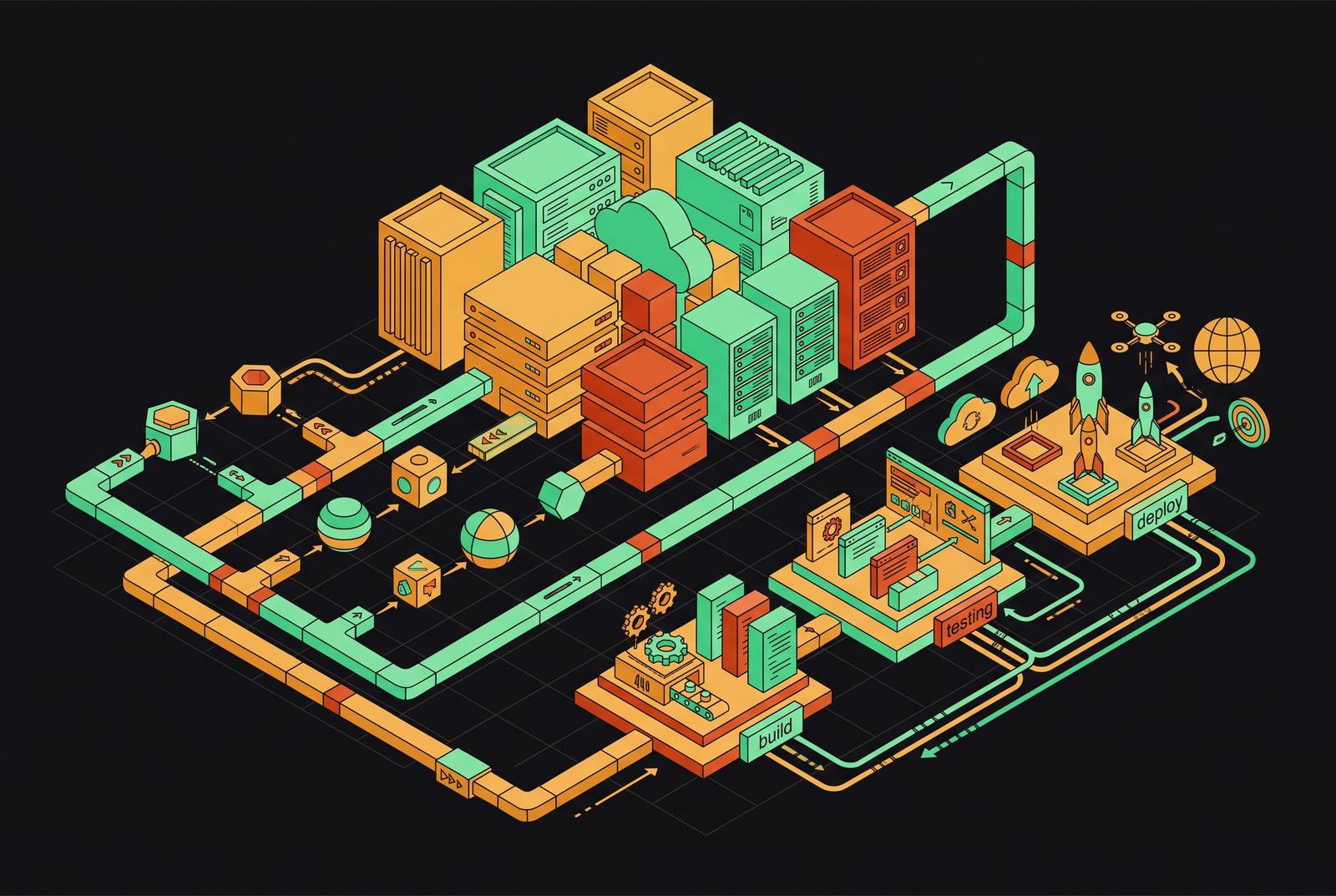
Cloud agent environments are the infrastructure layer that autonomous coding pipelines run on. Their job is to give agents a workspace where they can act, retain state, and keep working without a developer watching. But a durable workspace is only half the design. A useful pipeline also needs a firm boundary between what an agent can change and what people must govern.
Why autonomous coding pipelines need a dedicated environment layer
An agent reads a GitHub issue, explores the repository, implements a feature, runs tests, fixes failures, and opens a pull request. Along the way, it may install packages, change files, and repeat build steps without anyone supervising each command. The execution burden has shifted from developer to agent. The environment now has to support work that once depended on a person being present to decide and recover.
A conventional local setup assumes that person is nearby. Giving it more compute does not remove that assumption, nor does it provide the isolation and persistence needed for unattended work. Running model-generated commands in a shared local environment also exposes resources beyond the task itself. Unattended work requires both capacity and a way to keep a long-running task alive while limiting what a mistake or prompt injection can reach.
The core properties a cloud agent environment must satisfy
Isolation and persistence solve different parts of that problem. Isolation bounds the agent’s actions, while persistence keeps files, branches, and installed packages available across pauses, restarts, and disconnects. A microVM provides a stronger isolation boundary than a container because containers share the host kernel with other workloads. Neither property substitutes for the other. Even a well-isolated workspace that is thrown away after use cannot keep a task going if its progress is lost when the session ends.
Unattended operation adds another requirement, because work must continue when the developer closes their laptop. Credentials need to be injected at runtime and scoped to the task, with the repository cloned at a known branch. People still need access to the workspace. Teammates must be able to connect to review or continue the work, making the environment a shared artifact. For teams with compliance or data residency requirements, deployment in their own cloud account may also be necessary.
The billing model must fit this pattern of use. Agents can sit idle between tasks, so per-second billing and pauseable environments keep teams from paying for that idle time. Together, these requirements distinguish cloud development environments from sandbox APIs. A cloud development environment, or CDE, is a full, persistent workspace that survives across sessions. A sandbox API creates and destroys short-lived execution environments programmatically, fitting many brief code runs while lacking the persistence for sustained repository work.
How the observe-think-act loop drives environment design from the inside
The observe-think-act loop explains why workspace state is so important. The model invokes tools such as bash, Python, search, file editing, and test runners, then uses the results to choose its next action. Each pass changes what the agent knows or what exists in the repository. The next pass depends on that history. Losing the workspace mid-loop breaks the continuity between an edit, its test result, and the next attempt to fix it.
That continuity also has a cost. Context accumulates across multi-turn interactions, so longer loops consume more tokens and increase inference spending. Shorter loops with a clearer scope can cut that cost, but the agent still needs permission to act within its task. Northflank’s documentation describes a Harness model in which each task gets an isolated microVM configured with authentication, repository, branch, resources, and environment. That model maps a stateful task onto a bounded workspace that can sustain its repeated actions.
Where agentic authority ends and governance must begin in CI/CD pipelines
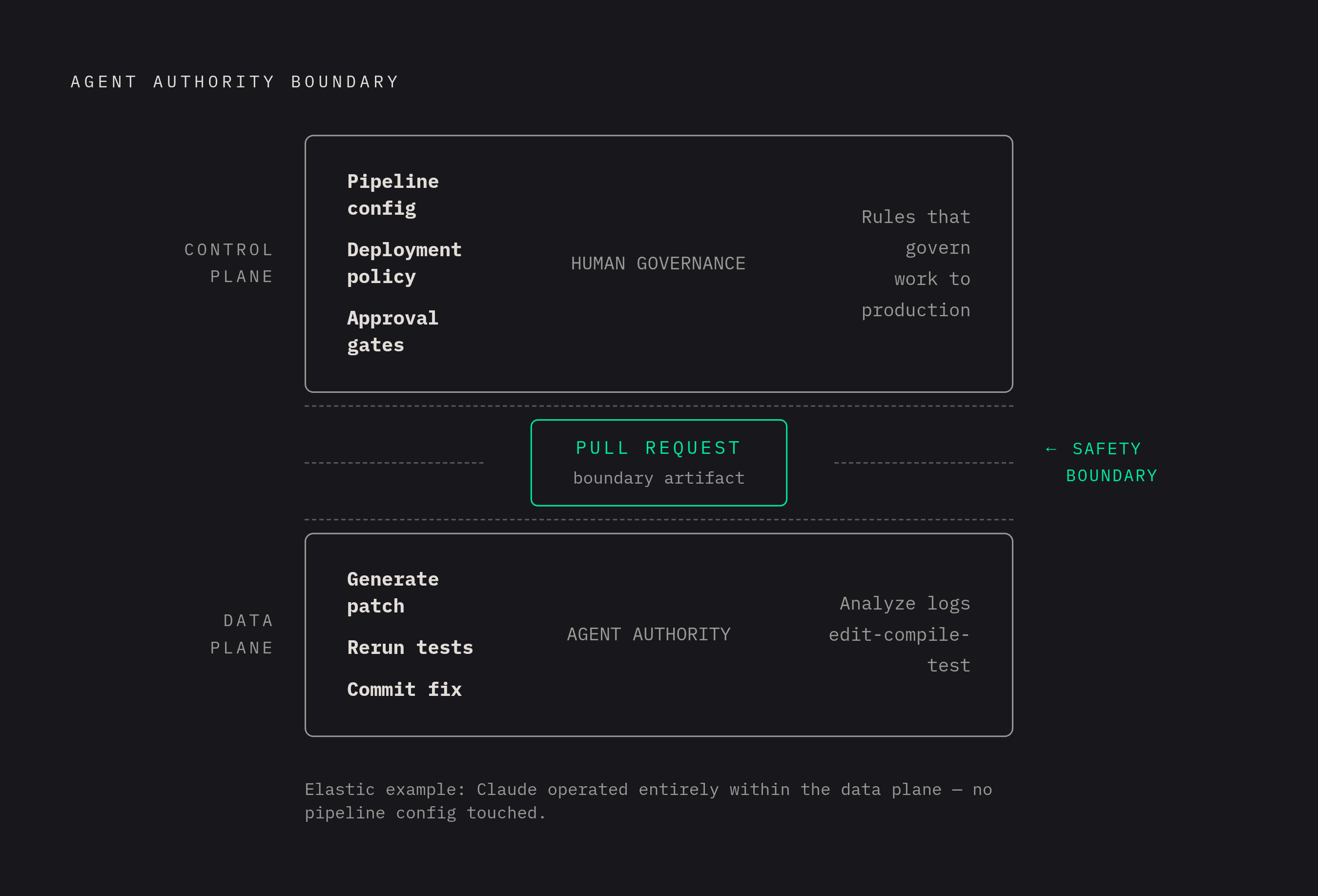
Barnes, Ghaleb, and Hassan’s paper, From Assistance to Agency: Rethinking Autonomy and Control in CI/CD Pipelines, separates data-plane authority from control-plane authority. Data-plane authority covers localized actions such as generating patches and rerunning tests. Control-plane authority covers changes to pipeline configuration, deployment policies, and approval gates. These are not equivalent kinds of permission. The second lets an agent alter the rules that govern how work reaches production.
The paper finds that constrained autonomy dominates current systems, with agents acting inside predefined spaces and humans approving work at integration points. Safety comes from surrounding governance, including pull requests and policy gates. The pull request therefore has a governance role. Removing it without replacing that function leaves an unacceptable gap, even if the agent remains effective at writing patches.
Bounded autonomy is still different from a smarter script because the agent interprets failures and chooses a response. But that choice introduces runtime authority over commands, secrets, and artifacts, which cannot be understood from pipeline definitions alone. The security model must account for those choices. For an engineer designing or operating the pipeline, the key distinction is whether an agent can act within existing rules or change the rules themselves.
What a production deployment actually looks like — Elastic’s CI/CD integration
Elastic’s Control Plane team added Claude to its CI/CD pipeline to manage dependencies in its monorepo. About 500 actively updated dependencies generated pull requests through Renovate bot, creating a volume of failed Gradle build logs that a human workflow could not efficiently process. Claude’s assignment was narrow but involved real judgment. It analyzed failed logs, iterated through edit-compile-test cycles, and committed fixes. It did not configure pipelines or set deployment policies.
Elastic reported broken pull requests fixed, commits made by Claude, and an estimated significant volume of developer-days saved in the first month. Claude became one of the repository’s top contributors. That output depended on more than model capability. The workspace had to keep changes across repair cycles and let the agent work on its own without a developer watching every step. The pull requests and CI gates already in place then governed that work.
Claude was not choosing which dependencies to update, setting merge policies, or making deployment decisions. Despite the team’s name, the agent’s role was entirely at the data plane.
How the current platform landscape maps onto these requirements
Northflank Cloud Harnesses provide an isolated microVM per agent task and support agents including Claude Code, Codex, OpenCode, and Pi, as well as Bring Your Own Agent. Harnesses run on Northflank’s managed cloud or in a team’s own cloud account through BYOC. The same platform also runs services, databases, jobs, and sandboxes. Per-second billing and pauseable environments address idle cost.
GitHub Codespaces fits teams that want a persistent workspace tied to a repository through one or more dev container configurations. It does not provide microVM isolation. Ona, part of OpenAI, instead has an agent-driven development environment with its own built-in agent, which suits teams that want the agent and workspace designed together. Coder addresses a different constraint through self-hosted development environments on infrastructure the team already operates. Its route to infrastructure control differs from Northflank’s managed platform with BYOC.
E2B is a sandbox API, which puts it in a different category from a persistent CDE. Its SDK gives applications short-lived sandboxes where they can run generated code in many brief runs. That distinction should drive the choice. E2B gives up persistence to be fast and simple, while persistent workspaces keep the state needed for repository tasks that take hours. For teams whose compliance requirements rule out vendor-managed infrastructure, where the environment runs is another factor in the choice, and BYOC and fully self-hosted environments offer different ways to run it.
Three agent archetypes and how environment requirements shift across them
CLI-first agents such as Claude Code, Codex CLI, Gemini CLI, and Copilot CLI use the command line as their interface to the workspace. They read repositories, modify files, run shell commands and tests, and orchestrate workflows. Their environment must support that range of actions. A persistent cloud harness with full shell access and package installation rights fits this model because the agent works through the workspace independently of an editor session.
IDE-native agents, by contrast, optimize for developer flow inside an editor. They use editor state, navigate symbols, edit multiple files, and run commands, usually with a developer present. The IDE session supplies much of their context. Cloud hosting is less common for this archetype, and “unattended operation” describes it less cleanly than it describes an asynchronous agent. A remote workspace alone does not change that working model.
Cloud engineering agents use asynchronous delegation to take an issue or task, run it remotely, and send the work back for review. OpenHands and Replit Agent 3 illustrate this pattern. OpenHands can start from an issue ticket, spin up a container, clone the repository, attempt a solution, and submit a pull request. The container bounds execution, while the pull request bounds integration. Identify the archetype before choosing infrastructure, because a short-lived sandbox can constrain a long-running CLI agent, while a full persistent CDE adds unnecessary cost and complexity to brief code execution.
What GitLab Duo’s general availability reveals about the maturity of agentic CI/CD
GitLab announced the general availability of GitLab Duo Agent Platform in January 2026. Its foundational prebuilt agents included the Planner Agent and Security Analyst Agent, with Code Review and CI/CD migration offered as separate agentic flows. Prebuilt workflows lower the integration cost for teams that would otherwise need to build their own harness.
The Security Analyst Agent, also generally available from January 2026, lets engineers triage, assess, and guide vulnerability remediation through natural language in GitLab Duo Agentic Chat. It explains vulnerabilities and security signals in plain language to help teams understand what to address first. Its role remains bounded. The agent analyzes and prioritizes, while people decide on remediation policy, consistent with the data-plane distinction in the paper.
The platform’s maturity does not settle how much authority its agents should have. Its agents work within predefined workflows, with people approving work at integration gates and the governance around the agents keeping that work safe. Teams inherit those choices when they adopt the product. As a result, less work spent building a harness does not mean less need to understand its permissions. Commercial packaging moves part of the engineer’s job from implementing the workflow to governing the authority model already built into it.
The open problems that engineers deploying these systems still have to solve themselves
Barnes and colleagues identify control-plane safety as the most urgent open problem. Current systems usually keep agents at the data plane by relying on convention and the governance around them, without a formal constraint. That distinction becomes critical when an agent can change pipeline configuration or deployment policy. A wider permission set is not a safety mechanism. Moving toward control-plane authority without such a mechanism leaves a hole in the design, even when the product works.
Evaluation has not caught up with deployment either. Existing benchmarks measure how well agents do tasks but leave out how they reason about authority boundaries or act within governance rules. Engineers have no standard framework for assessing whether an agent respects its scope. Human-agent coordination is similarly unsettled as work spans longer horizons and more complex workflows. Decisions about when to pause and escalate, rather than proceed and report, remain subject to ad hoc configuration.
Session management adds a separate operating problem. Context accumulation drives inference cost, while session length, context pruning, and subagent scope affect how much context the system consumes. There are no established best practices for those choices. Engineers therefore inherit both the governance questions and the cost tradeoffs, even when the execution infrastructure is ready to use. Their role is shifting from building pipelines alone to reasoning about the authority of the agents inside them, including who controls the rules and when a person must take over.