Cloud Agent Environment Setup for Startup Engineering Teams
Four checks and a Dockerfile keep agent-written code auditable.
Choosing a cloud agent environment sets your team's security posture, your observability model, and your shipping speed before a single line of agent-written code ever gets merged. That's the real stakes of this decision, and it's why "just try an agent plugin" stopped being a sufficient answer for a startup engineering team.
For years, the default model was human-in-the-loop: a developer made every decision, and tools assisted at the margins. That model is giving way to agent-in-the-loop, where an agent handles a multi-step task on its own, end to end, and a human reviews the result at defined checkpoints. The two models need different infrastructure underneath them.
Local development was built for the first model, and it shows its age fast under the second. A single laptop runs into port conflicts the moment two agent sessions try to use the same service. Workspace locks across branches turn into a queue of agents waiting on each other. Memory gets eaten alive when multiple sandboxed processes run side by side on hardware sized for one developer's editor and a browser tab.
Running an agent locally, with access to a developer's file system, credentials, and shell, is not an architecture a startup should accept anymore. When that agent touches a file it shouldn't, or a credential leaks because it sat in an environment variable on a laptop, there's no trail to reconstruct what happened. The incident is just discovered, late, with no record of how it unfolded.
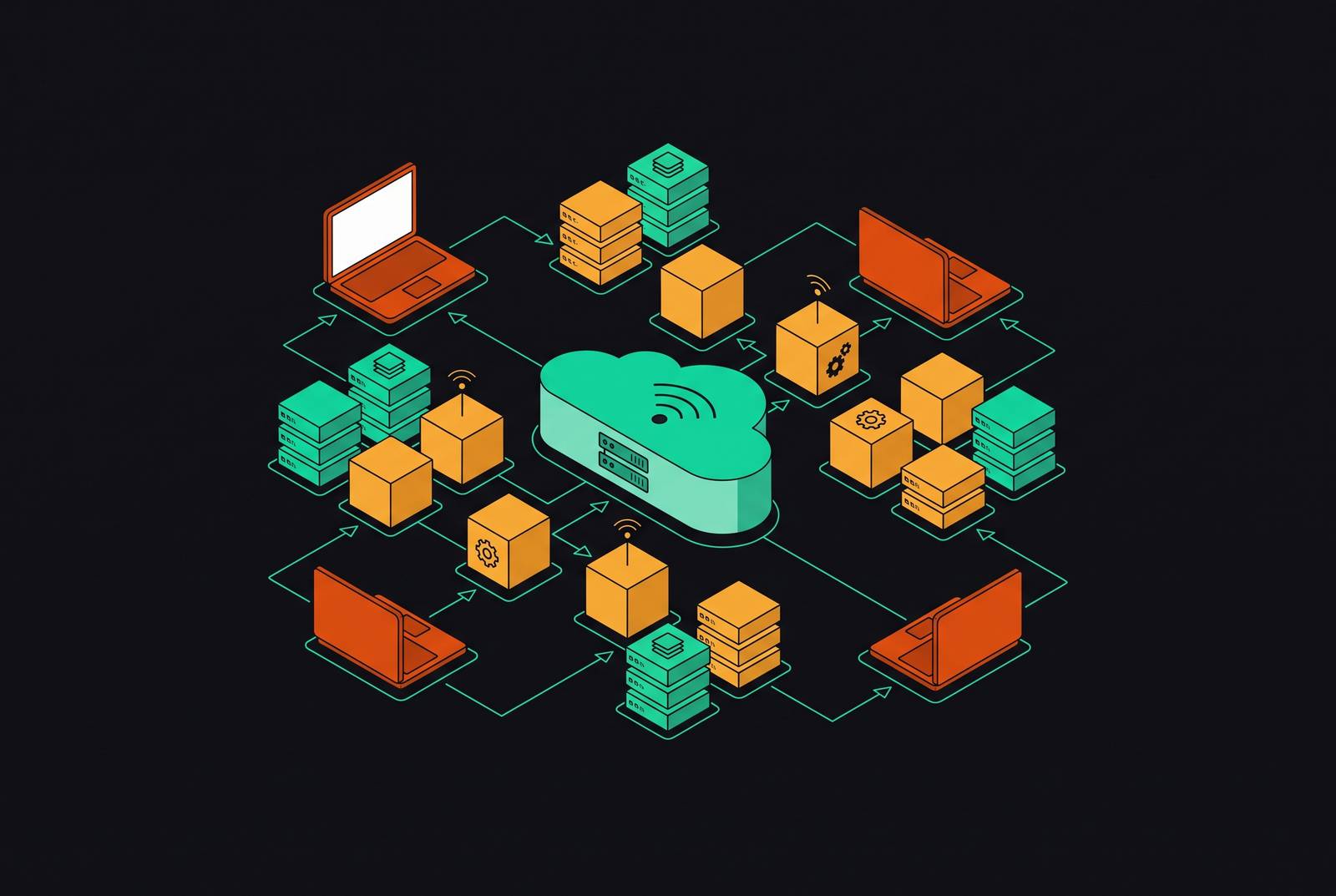
A cloud agent environment solves this by giving the agent its own managed space to work in: provisioned compute, an isolated workspace, its own shell and git state. The agent can run for minutes or hours unsupervised, then hand back a reviewable artifact instead of a half-finished change sitting in someone's local branch.
What a cloud agent environment needs to do (the four requirements lean teams forget to audit)
Four properties make a real setup hold up where a demo falls apart in production: isolation, observability, reproducibility, and governance, and skipping any one of them makes agent-written code unauditable, turning the environment itself into a liability.
Isolation means an agent's actions stay scoped to its own workspace, so a misconfigured task can't cause side effects outside its boundary. Picture a small cloud software factory: one agent working a bugfix branch, another running a refactor, a third living inside an end-to-end test sandbox, a fourth acting as a security watchdog scanning for issues. Each one gets its own environment, its own OS, its own database. Without that separation, parallel agent sessions bleed state into each other in ways nobody notices until a merge breaks production.
Observability means every tool call, every file diff, every decision the agent makes gets logged somewhere a human can read later. Startups without a dedicated platform org skip this constantly, usually because it doesn't look urgent during setup. The cost appears the first time a reviewer stares at a pull request and has no way to reconstruct what the agent actually did to produce it.
Reproducibility means the same task produces the same result every time it runs. Environment drift, where one developer is on one OS version and another is on a different one, is a class of problem a config-driven cloud environment removes from the table. If the environment is defined once and every session boots from that definition, drift has nowhere to creep in.
Governance means access and permissions get enforced by the environment itself, not assumed from whoever happens to be running the agent. A zero-trust agent identity model scopes permissions to the agent's own workspace. Run through these four against your current setup. Most teams find at least one gap.
Environment-as-code (the Dockerfile-based configuration pattern and why startup teams should adopt it first)
Treating the agent's execution environment as a versioned artifact, defined in a Dockerfile or equivalent configuration, is the highest-leverage setup decision a lean team can make. One file collapses isolation, reproducibility, and auditability into a single, inspectable artifact.
In practice, this means the environment spec lives in the repo next to the code it builds. No tribal knowledge is required to reproduce it: a new engineer, or a new agent session, reads the same file everyone else reads. Every agent boots from the same image, making drift between sessions structurally impossible. Version history on that environment file lets a team roll the environment back independently of rolling back the code, which matters when a dependency update breaks something unrelated to the feature being shipped.
Build secrets deserve particular attention here. Cursor's May 2026 update introduced build secrets in Dockerfile-based configuration, giving agents access to private registries at build time without exposing those credentials to the running agent itself. The pattern works like this: a credential needed to pull a private package gets passed in as a build argument during image construction, consumed once, and then discarded. It never becomes a runtime environment variable the agent can read, print, or accidentally paste into a log. The agent finishes with a working image and no idea what the credential was.
Layer caching is the speed argument for adopting this pattern early. Optimized caching lets a Dockerfile rebuild quickly when only a small change is made to it. On a lean team running dozens of agent sessions a day, that saved time compounds fast across a week of iteration.
Teams starting from zero don't need to write a Dockerfile by hand. Some platforms can inspect a repository and generate a starter Dockerfile automatically, cutting the cold-start cost of adopting environment-as-code. This capability is still rolling out in limited form for enterprise customers on at least one platform, so treat it as something to watch for.
Rollback and version history on environment configs should be restricted to admins, with every modification logged. It's an audit requirement, because if an environment change introduces a regression, someone needs to know who changed it, when, and what the previous version looked like.
Secrets management and network egress scoped per environment (the controls that prevent a messy blast radius)
Scoping secrets and network egress at the environment level, not the team level and not the org level, bounds how much damage an agent can do when it behaves unexpectedly. Startup teams that skip this control eventually pay for it in an incident, not in a code review comment.
The failure mode is simple to picture. A single shared secrets store means any agent session, compromised or just confused, can reach credentials for services it has no legitimate reason to touch. Scope secrets per environment instead, and a bugfix agent working on the frontend simply has no path to production database credentials, because it was never handed them in the first place.
Egress policies close the remaining gap. Network access policies can be defined at the user, environment, or team level, letting a team decide exactly which external endpoints a given agent session can reach. An agent that only needs to call one external API shouldn't be able to reach arbitrary internet endpoints just because nobody bothered to restrict it. Egress allowlisting enforces that boundary automatically, without requiring a human to review every outbound call an agent makes.
The objection that "we're five people, this is overkill" doesn't hold. The blast radius of a leaked credential scales with what the agent can access, not with how many people are on the team. A five-person startup running an agent with an over-permissioned secret is exposed to the exact same incident as a fifty-person company running the same misconfiguration. Team size has nothing to do with it.
For teams with strict data requirements, self-hosted mode is the heavier alternative. Self-hosted cloud agents became generally available on March 25, 2026, letting enterprise teams run agent infrastructure on their own servers, keeping code execution and build caches on the customer's own infrastructure. Some data still leaves that boundary: tool call results, which can include code, get returned to the vendor's cloud for inference, and session artifacts like screenshots and logs upload to vendor-managed storage by default. Connectivity runs one direction only, with each agent opening an outbound HTTPS connection rather than requiring inbound ports, firewall changes, or a VPN tunnel. For most early-stage startups, this is more infrastructure than the moment calls for. It belongs on the decision tree for teams handling regulated data from day one, not as a default starting point.
Zero-trust agent identity is the principle all of this rests on. Agents authenticate with least-privilege identities scoped to their own workspace instead of inheriting whatever credentials the person who launched them happens to hold. It's the same idea as a service account in traditional infrastructure, applied to a session that might live for twenty minutes instead of twenty months.
Multi-repo context (why single-repo agent setups break for real startup codebases)
Startup codebases typically span multiple repositories within their first few years, and an agent environment scoped to a single repo produces changes that break things it can't even see. Multi-repo context is a correctness requirement, not a feature a growing company adds later for convenience.
An agent operating in multi-repo mode pulls context from more than one codebase, which lets it understand how services depend on each other and make changes that respect those dependencies. Without that context, an agent fixing a backend bug has no visibility into the frontend contract it's quietly breaking on the way to a green test suite. The tests it can see pass. The ones it can't see fail somewhere else, later, for someone else to debug.
Multi-repo support tends to become a requirement earlier than teams expect, once agents start handling real cross-service work instead of isolated, contained tasks. Companies running these automations in production report that fixing issues across multiple repos is what makes the automation genuinely useful.
Granting that access has to be deliberate. Every repo an agent can read or write is an expansion of what it's capable of touching, so the grant should match a specific need, not default to cloning everything in sight. This is the same discipline from the secrets conversation, applied one level up: per-repo access tokens instead of a single org-wide token that opens every door at once.
The sequencing matters as much as the policy. Start with the repo where agent tasks are most contained, get that working cleanly, and only add cross-repo access once a specific task requires it and the scope of that access is defined ahead of time. Treat single-repo as the default starting point. Add multi-repo deliberately, task by task. Waiting until it's actually needed keeps the environment simpler at launch and keeps the permission surface as small as it can be for as long as possible.
Verification gates and review artifacts (what keeps agent-written PRs from becoming unauditable merges)
An agent environment with no verification gate is a productivity tool that produces bad merges faster. The review artifacts an agent generates, test results, screenshots, logs, command output, are what make autonomous code auditable without requiring a dedicated platform org to police it.
A verification gate, in practice, runs before a pull request ever opens: the agent runs the test suite, starts the application inside its own sandbox, and confirms the change hasn't broken any of the checks defined for that task. Failed tasks need to get recorded too. An agent that quietly drops a failing task and moves on is worse than one that surfaces the failure and hands it back for a human to look at, because the silent failure is the one nobody catches until it matters.
Review artifacts should include the diff itself, test output that shows pass and fail detail rather than a single green checkmark, command output showing what the agent ran, and browser evidence, screenshots or video, for anything touching the UI. One more number belongs on this list: the human time required to get the result into a mergeable state. That number tells a team whether the agent is actually saving time or quietly generating review debt that someone pays down later.
Audit logs produce the record everything else here depends on, because without them a reviewer has nothing to reconstruct what happened. Every tool call, every file diff, every decision an agent makes should be logged, not for the sake of compliance theater, but so a reviewer can reconstruct what happened the moment something looks off. Comprehensive logging on environment modifications belongs to this same governance layer described earlier, not bolted on afterward as an afterthought.
The standard objection is that engineers will just read the diff themselves. At low agent volume, that works fine. Once agents are producing a meaningful share of merged pull requests, reading every diff without supporting evidence is how subtle regressions slip through, because a diff alone doesn't show whether the tests actually ran or what the agent tried before landing on its final answer. The verification gate does double duty here: it protects the merge, and it tells the team whether to trust that particular agent on that particular class of task going forward.
The build-vs-buy decision for the orchestration layer (what startup teams need to own)
Startup teams without a dedicated platform org should own their orchestration logic and their repository-access rules, and buy the execution infrastructure underneath both. Building the isolation layer, the logging layer, and the secrets layer from scratch is a tax that compounds against shipping speed, paid every sprint for infrastructure that isn't the product.
Three positions make up this decision. Buy the commodity workflows, running inside a single vendor system, when the startup's differentiation has nothing to do with the agent infrastructure itself. Most startups fall here: the value they're building lives in the product, not in a custom-built sandbox orchestrator. Build the pieces that encode specific judgment calls about the business, such as which repos an agent is allowed to touch for a given task type, or what counts as a passing verification gate for a particular kind of change. Those rules are specific to how a team works, and no vendor can write them in advance. Own the decision framework that ties the two together: which tasks run through which environment, which secrets get scoped to which agent, which verification gate applies to which class of change.
Getting this allocation right is what separates a team that ships faster with agents from one that spends its engineering time rebuilding infrastructure the industry already solved. The orchestration logic and the access rules encode judgment about the business. The execution layer, the sandboxes, the compute, the logging pipeline, is infrastructure a lean team is better off buying than building.